
Orchard Park, NY homeowners deal with changing conditions that can affect tree stability throughout the year. Heavy snow and ice can add weight to branches, while strong winds and seasonal storms can expose weak limbs or damaged trunks. Trees growing close to homes, driveways, fences, and utility lines deserve particular attention because structural problems can become property hazards.
Knowing the warning signs can help homeowners recognize when a tree needs professional evaluation before a minor issue becomes an emergency.
1. Look for a Sudden Lean
A naturally angled tree is not necessarily unsafe. The concern is a new or rapidly changing lean, especially after strong wind or heavy weather.
Check the ground around the trunk for raised soil, cracks, or exposed roots. These signs may indicate that the root system has shifted.
A tree leaning toward a house, driveway, or frequently used area should be evaluated from a safe distance.
2. Check for Large Dead Branches
Deadwood can become brittle and break during wind or winter weather. Large dead branches above roofs, vehicles, or walkways deserve attention.
Signs of dead branches may include:
No foliage during the growing season
Loose or peeling bark
Broken branch tips
Dry, brittle wood
Hanging limbs
Do not climb the tree or attempt to cut large branches yourself.
3. Watch for Cracks and Splits
Deep cracks in the trunk or major branches can indicate structural weakness. A split branch union can also fail under additional weight or wind.
Fresh cracks deserve particular attention after storms or periods of heavy snow and ice. If a major crack appears above a structure or area where people gather, professional assessment is appropriate.
4. Inspect the Root Area From a Safe Distance
Roots play a major role in keeping trees stable. Problems with the root system may not be obvious until a tree begins to lean or the surrounding soil changes.
Look for:
Exposed roots
Raised soil
Soil erosion
Cracks near the trunk
Mushrooms or decay around the base
Recent changes in the tree's position
Avoid digging around the roots to investigate. Disturbing the soil can make an existing problem worse.
5. Look for Storm-Related Damage
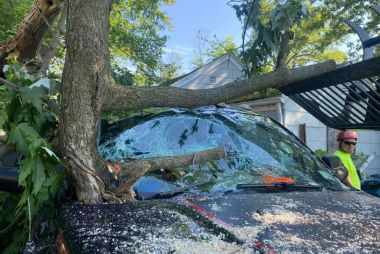
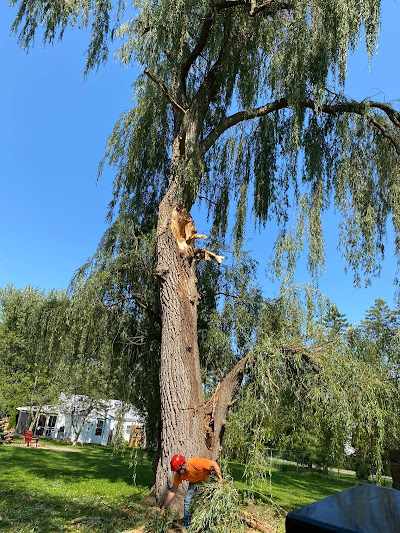
Severe weather can damage a tree even when it remains standing. Broken branches may become lodged high in the canopy, while cracks can develop in the trunk or major limbs.
After a storm, check trees from the ground. Look for hanging branches, fresh breaks, unusual leaning, and debris caught in the canopy.
If a tree or branch has contacted a power line, stay away and contact the utility provider. Never attempt to remove it yourself.
6. Pay Attention to Declining Tree Health
An unhealthy tree may show several changes over time. Sparse foliage, dead sections, damaged bark, fungal growth, and repeated branch dieback can all warrant closer inspection.
These symptoms do not automatically mean the tree should be removed. Disease, insects, root problems, environmental stress, and physical damage can have similar symptoms.
The cause should be identified before deciding on pruning or removal.
7. Consider the Tree's Location
Tree safety depends partly on what could be damaged if a branch or tree fails.
A structurally weak tree near an open field presents a different risk from one positioned beside a home. Trees close to roofs, garages, driveways, fences, roads, or utility lines may require more careful evaluation.
Orchard Park homeowners dealing with storm damage, declining trees, or overgrown branches may need to determine whether inspection, pruning, or removal is the right option. Local tree-care information can help property owners understand these choices and know when professional help may be needed. Homeowners looking for local assistance can learn more about tree care services in Orchard Park, NY from Buffalo Tree Service.
What Should You Do If a Tree Looks Unsafe?
Do not climb, cut, or attempt to stabilize a large damaged tree yourself. Keep people and pets away from the area until the hazard can be assessed.
A professional tree-care evaluation can consider the tree's trunk, branches, root system, lean, surrounding structures, and overall condition. In some cases, pruning may reduce a hazard. In others, removal may be the safer option.
Frequently Asked Questions
What is the clearest sign that a tree may be unsafe?
A sudden lean, major trunk crack, split branch, lifted roots, or large hanging limb can indicate a serious structural problem.
Can a leaning tree always be removed?
No. Some trees naturally lean without being unstable. The cause, direction, root condition, and surrounding property risks all matter.
How does winter weather affect tree safety?
Snow and ice can add weight to branches, while wind can place additional stress on weakened limbs and trunks. Damaged trees should be monitored after significant winter weather.
Should I inspect a tree after a storm?
Yes, but only from a safe location. Look for broken branches, cracks, exposed roots, and changes in the tree's position. Do not climb damaged trees.
When should a homeowner call a tree professional?
Professional help is appropriate when a tree has major structural damage, is leaning unexpectedly, has large hanging branches, or is close to a building or power line.
#OrchardParkNY #TreeSafety #TreeCare #TreeHealth #StormDamage #TreeRemoval #NewYorkHomeowners
Write a comment ...